Most advice on LinkedIn is anecdotal. 'Post at 9 AM!' 'Use 3 hashtags!' This is cargo-cult marketing. To win in 2026, you need to think like an engineer, not a copywriter. You are not writing for humans; you are writing for a Relevance Scoring Algorithm. This guide breaks down the physics of viral distribution.
1. The Core Mechanic: 'Dwell Time' is King
In 2024, LinkedIn shifted its core metric from 'Clicks' to 'Dwell Time'. If a user stops scrolling and spends 15+ seconds on your post, you win. If they click 'See More' and immediately leave, you are penalized.
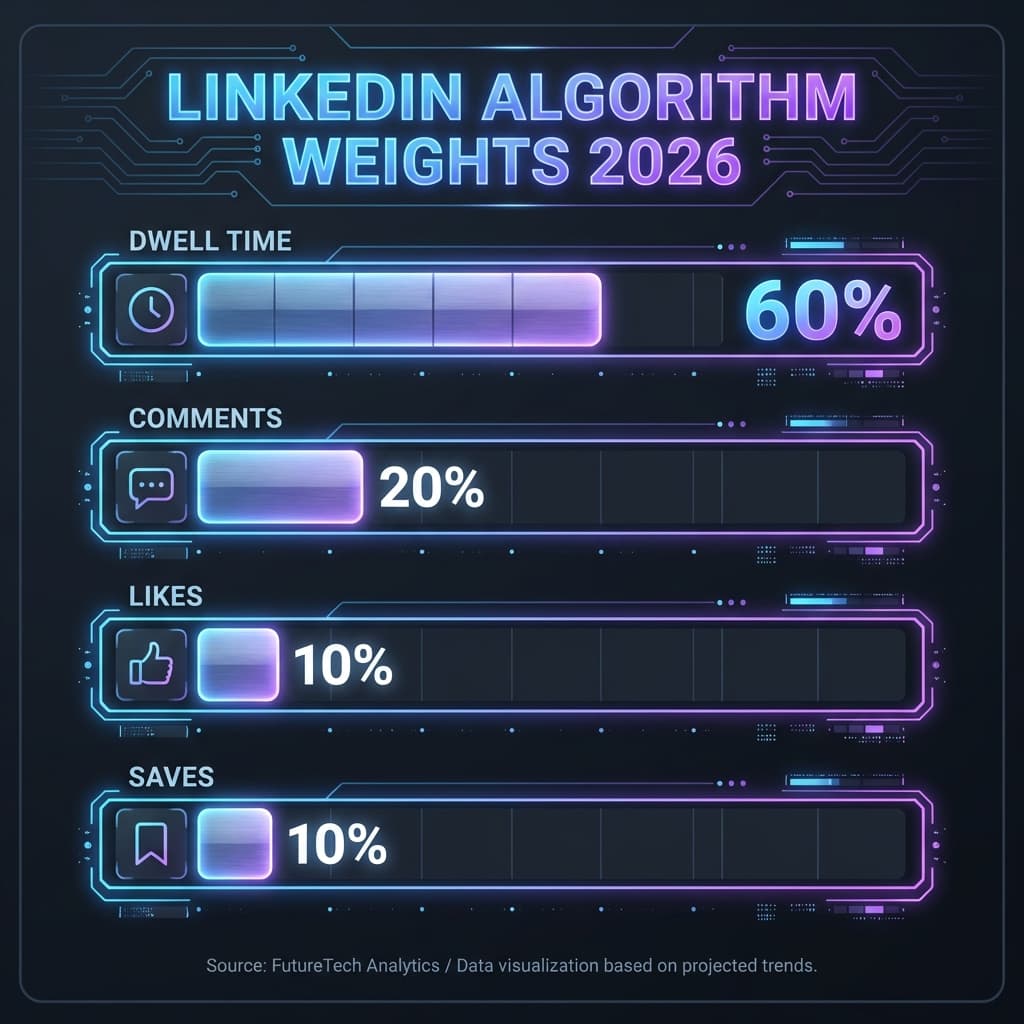
The Formula for Dwell Time:
- The 'See More' Trap: Your first 220 characters are the only thing that matters. You *must* force a click on 'See More' to trigger the dwell timer. A question works best.
- The Loop: Comments are not just engagement; they add dwell time. A 50-word comment keeps a user on your post for 10 extra seconds. Reply with questions to extend the session.
- The Dopamine Spike: Use specific numbers in your hook. 'How I made $10k' beats 'How to make money'.
2. The 'PDF Carousel' Arbitrage
Why do PDF carousels continually go viral? Because every swipe counts as a distinct interaction signal. A 10-slide carousel guarantees 30-60 seconds of dwell time. It is an algorithmic cheat code.
The Perfect 8-Slide Structure:
- Slide 1 (The Hook): A provocative statement (e.g., 'SaaS Sales is Dead'). Big font. High contrast.
- Slide 2 (The Data): A chart or graph proving your point. Establishing authority early.
- Slide 3-6 (The Framework): Step-by-step actionable advice. No fluff. Dense value.
- Slide 7 (The Summary): A bulleted recap for skimmers.
- Slide 8 (The CTA): 'Save this post for later'. Saves are the highest-weighted signal for 'Quality'.


